Phasing out PFAS from food contact packaging
Discussion Paper and consultation
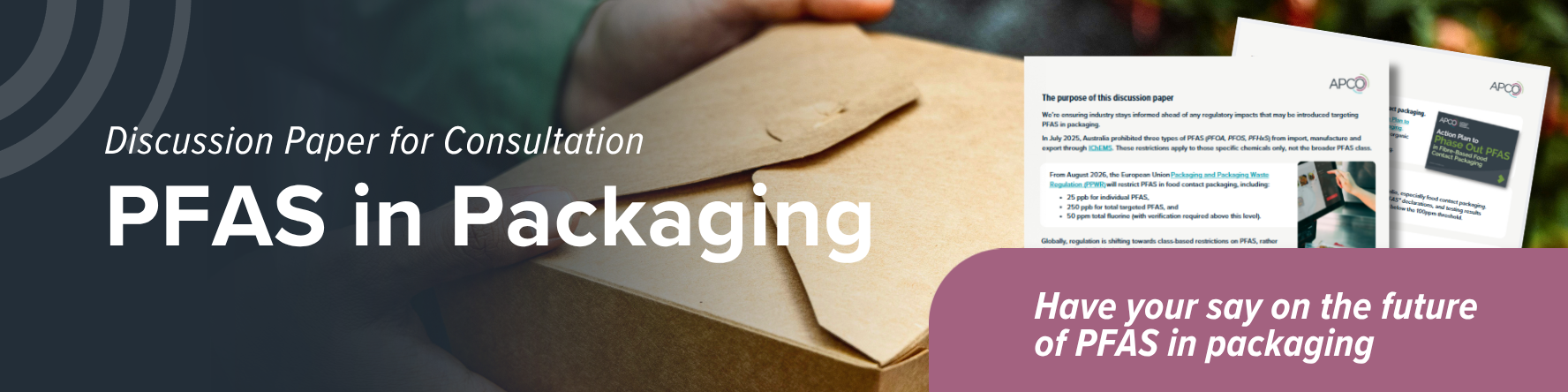
In May 2026, APCO released a PFAS Discussion Paper, which aims to build upon APCO’s 2022 Action Plan to Phase Out PFAS in Fibre Based Food-Contact Packaging and the work already underway by industry to phase out these chemicals in packaging.
The Discussion Paper:
- Investigates the opportunities to expand the phase-out of PFAS from fibre-based food contact to all packaging.
- Reviews the methodologies for testing for PFAS in light of regulatory developments.
- Sets out the policy and regulatory context that businesses placing packaging on the Australian market should be aware of when it comes to the use of PFAS in packaging.
- Seeks the view of members and stakeholders on an update to the approach on PFAS set out in APCO’s 2022 PFAS Action Plan.
Read the discussion paper here.
You can also watch a presentation outlining the Discussion Paper and key proposals here.
Have your say
APCO is seeking feedback on the six proposals set out in the paper include expanding the scope of the phase out to target all food contact packaging, timings for the phase out, a potential future lowering of the threshold for ‘No intentionally added PFAS’, and reviewing guidance for testing.
Proposals for discussion

Access the survey here. We will be seeking feedback until 16 July 2026.
Following analysis of feedback, APCO will communicate findings with participating members and provide an update on the timeline for updates to the Action Plan. Further communication and consultation will be undertaken as needed.
APCO is also be interested in hearing from members interested in being involved in a PFAS technical working group to help finalise definitions, evidence requirements, and supporting tools.
For any questions or other feedback, please contact us at apco@apco.org.au .
About PFAS
Per- and polyfluoroalkyl substances (PFAS) are a group of several thousand fluorinated compounds, characterised by strong chemical bonds that make PFAS chemicals useful for a range of applications, including within some food contact packaging.
PFAS compounds are, however, very resistant to degradation in the environment, which makes them potential environmental pollutants. Recent data from the Australian Bureau of Statistics (ABS) has shown that three types of PFAS were detected in the blood of over 85 per cent of the Australian population.
Timeline
PFAS in Fibre-Based Packaging Report (2021)
In 2021, in partnership with Planet Ark and with funding provided by the Department of Agriculture, Water and the Environment, APCO undertook a study to identify the presence of PFAS in fibre-based food contact packaging.
Nine APCO Members participated in the study, providing 74 package samples to test total fluorine concentrations.
The results revealed 45.9% of these samples contained total fluorine concentrations above the 100 ppm threshold, which is a reliable indicator that PFAS had been intentionally added to the packaging material.
During the study, it also became apparent that there was confusion among APCO’s members about PFAS, including the different types of PFAS and varying regulations. In addition, misunderstanding among suppliers about PFAS was leading uncertainty about the presence of PFAS in supplied packaging.
Action Plan to Phase out PFAS (2022)
In September APCO published its ‘Action Plan to Phase Out PFAS in Fibre-Based Food Contact Packaging’. It serves as both a framework to drive a national, industry-led approach to phasing out PFAS, and a resource providing businesses with support to identify PFAS in fibre-based food contact packaging and plot a pathway to phase it out.
It includes:
- a guide on how to test for total organic fluorine (TOF) which is indicative of PFAS.
- a step-by-step outline of how to report on the PFAS present in fibre-based food contact packaging.
- considerations for selecting alternatives.
The Action Plan supports the implementation of the National PFAS Position Statement agreed to by all Australian governments in 2018 and the achievement of the 2025 National Packaging Targets, including the target for 100% of packaging to be reusable, recyclable or compostable and the phase out of problematic and unnecessary single-use plastic packaging by 2025.
PFAS testing in APCO Member Annual Reporting (2025)
PFAS reporting was incorporated into APCO Annual Reporting for the 2025 reporting round, with all Members encouraged to undertake testing of in-scope packaging and report to APCO on the results annually. APCO is considering ways to engage with members to increase the uptake of reporting on the phase out.